
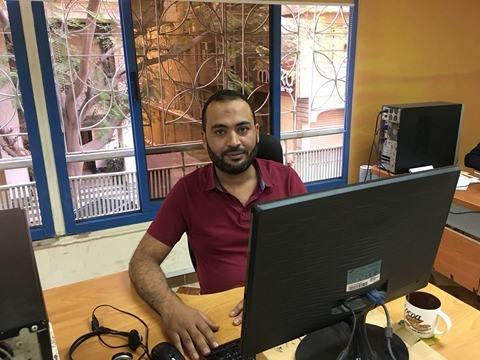
To begin with, we would like to know how you found your way into the world of software, and what drew you to this field?
I first got to know computers in preparatory school, through reading three books about computers and how they work. My love of computers and my enthusiasm took over, and I wanted to specialise in a field connected to them. I duly enrolled in the Faculty of Computers and Information. I learned a great deal during my studies and afterwards, and while serving in the armed forces I designed a program to manage the unit.
Anyone who is passionate about what they produce — whatever their level of intelligence or the extent of their knowledge — will be able to innovate, and will always try to improve what they make.
Where did the idea of founding Namasoft come from?
Many software companies in Egypt and the Arab world do not follow scientific methods for developing software. Many programs run on old technologies that have not kept pace with the developments taking place in this field. And as we all know, software is one of the industries that evolves fastest, every single day.
That was the starting point for the idea of founding Namasoft: a company that would address all of these problems.
Its goals: to use modern technologies.
To be ready for whatever developments may come.
Why was the name Namasoft chosen? And we would like to know more about the company.
First, the idea behind the name Nama. One of the hardest things when setting up a new company is choosing the name. It has to be easy to pronounce in both Arabic and English, easy to search for, and not already in wide use.
The idea of the name Nama came from growth (numuw). It is easy to pronounce in Arabic as well as in English, and it is not widely used. We felt that Nama was one of those names that is deceptively simple.
About Namasoft:
Nama is one of the promising companies developing ERP — enterprise resource planning — systems.
It is a system that serves many sectors.
We always strive to exceed our customers’ expectations. We want the customer to see something new in Nama at all times; we do not wait for a comment or a complaint from the customer. We always try, before the customer complains, to offer them everything that will improve their operation further and meet all of their needs.
That is indeed what has happened with most Nama customers. To put it more clearly, some customers had a different way of thinking before they started with the Nama system, but that changed with Nama.
For example:
How can they develop their business?
How can they get their work done and thereby maximise profit?
Their thinking changes as a result of the advanced capabilities the customer sees in Namasoft’s products at their own place of work, since Nama releases updates continuously.
The system can be configured to send alert messages for specific events in the database, such as an item reaching its reorder level or a customer exceeding their credit limit.
Addressing customer problems that may not even be visible to them can be more important than meeting their stated requirements, and it saves them a great deal of time and effort. This is what gives the customer a sense of comfort and confidence with the Nama system, as they feel a continuous improvement in how work gets done.
What are Namasoft’s goals?
To begin with, Nama offers its customers a service that competes with international companies.
Nama competes with those companies at competitive prices when offering Nama systems to medium-sized businesses.
Nama in the future: we have noticed a large segment we are missing, namely small companies. We are therefore thinking about designing systems to serve this large segment of small companies in a way that does not affect Namasoft’s performance.
Namasoft’s goals:
Developing the company’s services.
Developing its technical support services.
Reducing setup time at the customer’s site.
Extending the capabilities of Nama systems.
Always continuing to listen to the customer.
Which sectors does Namasoft cover?
Namasoft covers most sectors, the best known of which are:
Retail: this was the first sector we started working in, back in 2011.
(Consumer electronics retailers, food distributors, and distributors with their own particular approach to manufacturing and distribution.)
Pharmaceuticals: Nama covers the full document cycle, from the issue of raw materials
through to the finished product, including quality control and verification, and then the start of the product sales cycle.
Nama also supports MRP — manufacturing resource planning — so that raw material purchasing and product manufacturing can be planned on the basis of purchase orders, sales orders and market forecasts.
Real estate investment:
We support systems for selling and leasing property. With leasing systems, for example, the annual increase can be handled in several ways and on specific bases. For instance:
Is the increase tied to the basis of the contract?
Is it tied to the last increase applied?
Is the increase variable or fixed?
As for sales contracts, we support property reservations, preliminary agreements and the various instalment plans according to the customer’s preference, backed up by notifications for the instalments due from the customer as they arise.
We support the relationships between residential units, such as a unit and its garage; a unit can also be sold on its own or alongside other units, taking into account the area of each unit and whether it comes with a garden, and so on. Nama supports a very large number of fine details that may mean a great deal to the customer.
Contracting:
Nama supports many different contracting models, such as construction contracting, supply contracting and maintenance contracting.
For example, if the customer has a contract to fit out or furnish certain buildings or hotels, then with the Nama contracting system they can track building maintenance, refurbishment, or maintenance of the equipment installed, and more.
The Nama system covers contracting projects from the issue of the tender document and bills of quantities and the definition of contract line items, through quantity surveying, the issue of interim payment certificates and the tracking of collection and execution percentages, linking all of this to subcontractors, and on to the issue of the final payment certificate and project closeout.
The system allows any number of conditions to be defined, such as those relating to retentions, performance guarantees, advance payments and so on.
Automotive service centres:
Nama provides a system dedicated to service centres — not only for cars, but also for other service centres such as authorised repair centres for electrical appliances. In general, though, through this system Nama offers a comprehensive service for automotive dealerships and service centres.
Nama supports vehicle servicing, whether planned — such as periodic servicing — or unplanned, in addition to handling emergency services and other services
such as oil changes, filter changes, the five-thousand-kilometre service and so on.
Through Nama systems, the service centre can also track service prices in detail.
Among the best-known customers in this sector is the authorised dealer for Nissan, Xpress Egypt.
Nissan Xpress Egypt
Vehicle sales:
Nama’s solutions can also be used in vehicle sales, where Nama supports purchasing from the distributor and tracking letters of guarantee, traffic clearance letters and requests for traffic clearance letters, as well as tracking each vehicle and its associated sales order.
Nama supports the tracking of consignment vehicles, since most dealers display vehicles on consignment in their showrooms on behalf of the distributor.
Namasoft covers other sectors as well; you can visit the website to find out more.
Finally, we would like to thank Eng. Ahmed Qasid for this interview.
Edited by
Aya Khaled